When developing silicone rubber products, choosing the correct molding process not only affects product quality but also directly determines tooling budgets and long-term production costs. Below is an in-depth analysis of the differences between traditional solid compression molding and modern automated liquid silicone injection:
1. Solid Silicone Vacuum Compression Molding
This is a long-standing, mature molding method using pre-mixed solid silicone compound (clay-like texture).
- Production Process: The raw compound is cut and weighed, then manually placed into preheated steel mold cavities. A hydraulic press closes to apply high temperature and pressure, curing and vulcanizing the silicone within the mold.
- Advantages: The difficulty of mold development and precision requirements are relatively low, making initial tooling costs more economical. It is highly suitable for low-to-medium volume production, especially for larger, simpler silicone components (such as anti-vibration rubber pads, seals, and large protective covers).
- Disadvantages: Manual material weighing and placement limit production efficiency. It results in thicker flash, with dimensional tolerances depending on mold and part design, making it less suitable for ultra-intricate precision parts.
2. LSR Liquid Silicone Rubber Injection Molding
This is an automated injection process designed to meet the demands of precision polymer products, using two-part (Part A and Part B) low-viscosity liquid silicone.
- Production Process: Part A and Part B raw materials are mixed at a precise 1:1 ratio and injected directly into heated closed mold cavities via a precision runner system, curing rapidly in seconds to tens of seconds.
- Advantages: Production with extremely short cycle times. Thanks to the excellent flowability of liquid silicone, it can produce ultra-complex, thin-walled, micron-level parts, with with dimensional tolerances controlled to precision levels. The process generates minimal flash, and the fully enclosed piping prevents human/environmental contamination, making it ideal for medical-grade silicone parts and electronic-grade waterproof seals.
- Disadvantages: The mold design is highly sophisticated (requiring precise runner control and high vacuum venting), leading to expensive initial tooling costs. High-volume mass production is recommended to achieve optimal tooling depreciation.
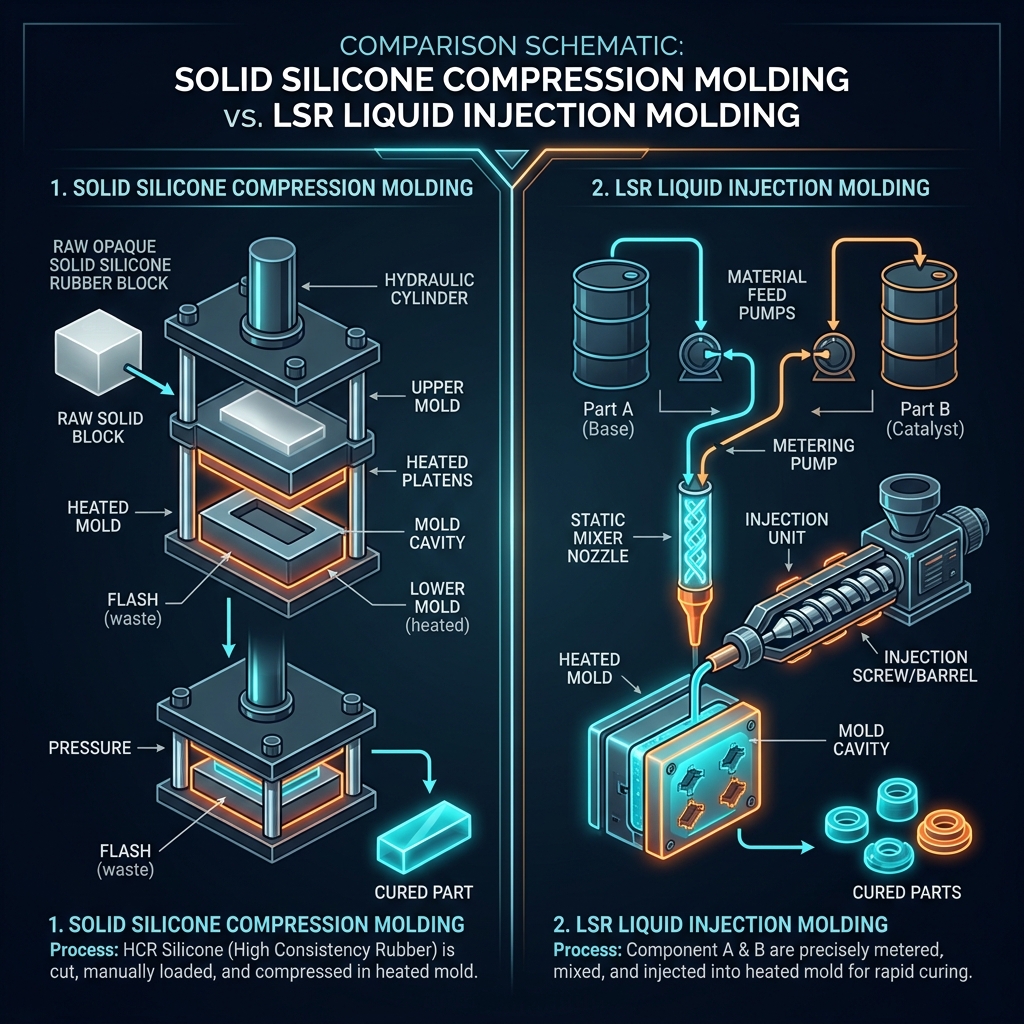
▲ Comparison of solid silicone hot pressing and automated LSR injection molding processes
Process Selection Matrix:
| Evaluation Metric | Solid Compression Molding | LSR Injection Molding |
|---|---|---|
| Tooling Cost | Low to Medium (Economical) | High (Technically Demanding) |
| Part Unit Cost | Medium (Includes manual labor) | Low |
| Precision / Tolerance | Depends on mold design | Precision / Micron level |
| Suitable Volume | Low to Medium (1K - 20K) | High Volume (>10K+) |
Submit 2D/3D CAD Drawings for Quotation
Have a custom silicone or rubber project? Submit your 2D/3D CAD drawings (.STEP, .IGES, .DWG, .PDF) directly via email for evaluation and quotation. We execute mutual Non-Disclosure Agreements (NDA) prior to reviewing any proprietary engineering drawings.