In the era of rapid development of Artificial Intelligence (AI) and Unmanned Aerial Vehicles (UAV), hardware stability directly determines the performance of algorithms and control systems. Operating in environments characterized by high voltage, high heat, high-speed vibration, and highly variable outdoor weather, high-end precision silicone rubber components play the role of "unsung heroes." Below are the key applications and design trends in these two core areas:
1. Key Applications of Silicone Rubber in AI Servers & Hardware
AI computing chips (such as GPUs and ASICs) release massive amounts of heat under heavy loads, and high-speed cooling systems introduce micro-vibrations, placing strict requirements on hardware sealing and shock absorption:
A. Efficient Thermal Interface Materials (TIM)
Ultra-high thermal conductivity silicone sheets or thermal gels must be used between AI chips and heat dissipation modules. By adding ceramic powders such as alumina, boron nitride, or silicon carbide, silicone provides excellent heat transfer efficiency (3.0~8.0 W/m·K or higher) while maintaining electrical insulation and soft elasticity (Shore A 10°~25°).
B. Liquid/Water Cooling Leak-Proof Gaskets
To break through heat dissipation bottlenecks, AI cabinets are rapidly shifting to liquid cooling. Gaskets and water-way seals manufactured via LSR (Liquid Silicone Rubber) injection molding possess extremely low compression set (requiring < 10%) and high chemical degradation resistance. They maintain 100% leak-proofing over years of high-temperature cycling, protecting expensive boards from moisture damage.
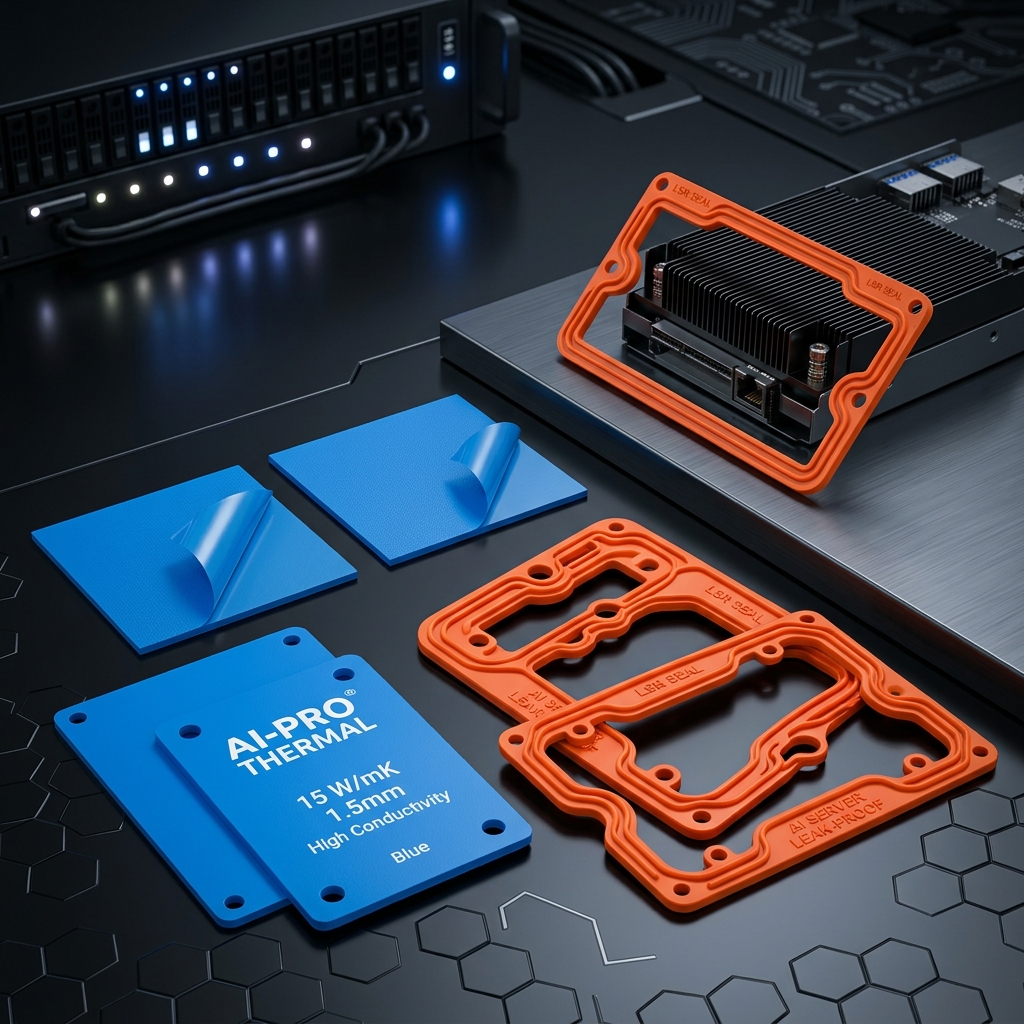
▲ High-conductivity thermal sheets and high-sealing LSR gaskets produced by Jun-Hsiang
C. EMI Shielding Gaskets
AI servers host numerous high-frequency communication modules where electromagnetic interference (EMI) can severely degrade data rates. We mix conductive particles like nickel-graphite or silver-copper into silicone to produce co-extruded or molded EMI shielding gaskets. These shield high-frequency noise, keeping volume resistivity below 0.01 Ω·cm.
2. Technical Demand of Drones (UAVs) for Precision Silicone Rubber
Drones must withstand high-altitude freezing temperatures, rain wash, and high-speed motor rotation. They are highly sensitive to lightweight construction, shock absorption, and weather resistance:
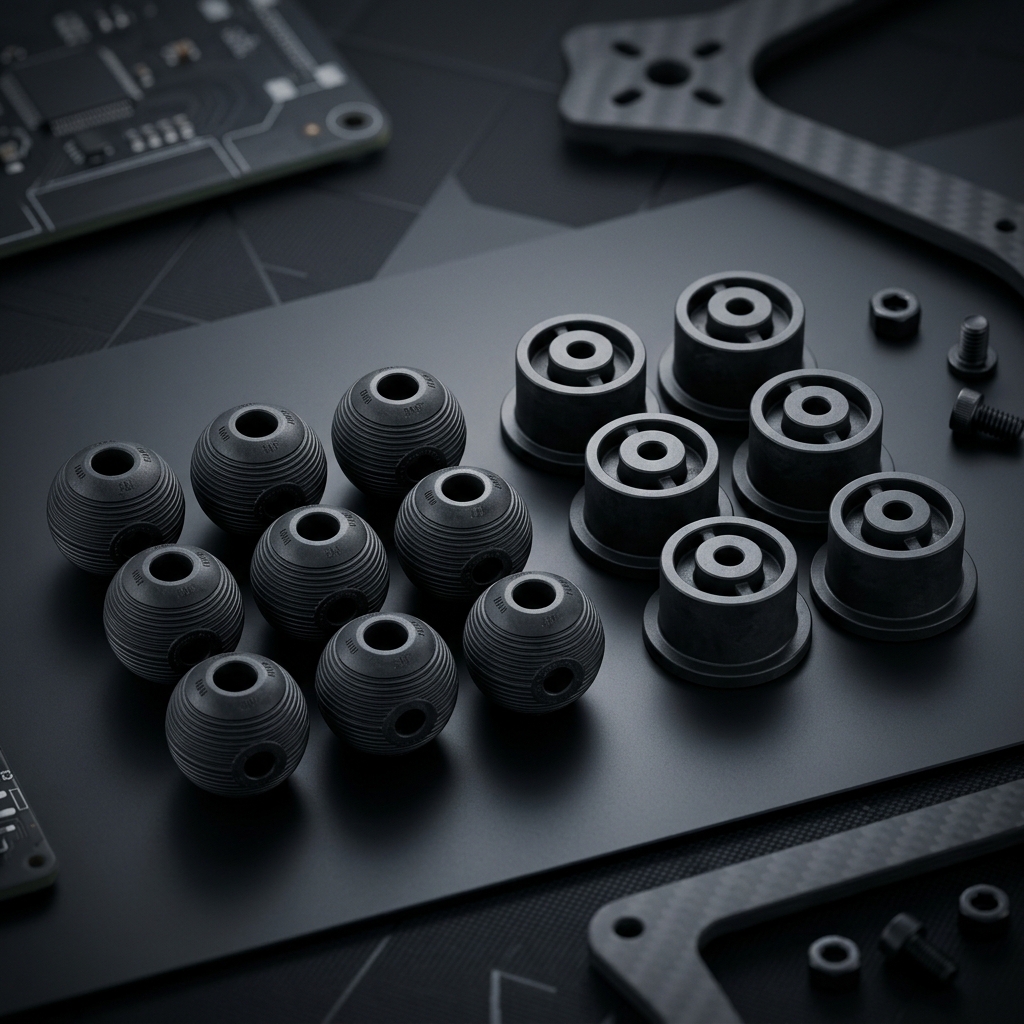
▲ Drone gimbal dampening balls and metal-bonded motor mount dampers by Jun-Hsiang
A. Gimbal Camera High-Damping Balls
The high-speed rotation of drone propellers causes high-frequency jitter (jello effect). Gimbal dampening balls must utilize silicone rubber with excellent resilience and damping coefficients, with carefully calibrated hardness (typically between Shore A 30° to 45°), to perfectly absorb micro-vibrations and ensure stable aerial photography and inspection footage.
B. Motor Mount Dampers (Rubber-to-Metal Bonding)
A drone's motor mount is the origin of heat and vibration. Utilizing **rubber-to-metal bonding technology**, aluminum alloy inserts are covalently bonded with custom NBR rubber inside the mold. This eliminates secondary assembly, provides high pull-out strength, isolates motor heat, and prevents motor vibrations from interfering with the IMU/gyroscope sensors.
C. Landing Gear Shock Absorbers
Using high-wear, tear-resistant NBR or PU rubber buffers on landing gear feet dampens landing impact forces, preventing micro-fractures in the drone's carbon fiber arms over time.
D. Servo Dust Boots
On the tilt-rotor joints and servo linkages of VTOL drones, ultra-thin (0.3mm~0.5mm) bellows made of high-strength silicone are used. They protect servo gearboxes from agricultural chemical sprays, dust, and rain without adding rotation resistance.
E. IP67/高規格防水密封 Enclosure Seals via LSR Overmolding
For all-weather drones (e.g., patrolling in rain or marine rescue), battery bays and housing joints require robust seals. **LSR double-shot overmolding** direct-bonds liquid silicone onto rigid PC/PA plastic frames, offering zero assembly tolerances and preventing peel-off or leakage from -40°C to 85°C.
Material Specification Guide for AI & Drone Applications:
| Component | Material | Core Spec Guideline | Key Process |
|---|---|---|---|
| Chip Thermal Pad | Ceramic-filled Silicone | 3~8 W/m·K, Shore A 15° | Mixing Extrusion / Die-cut |
| Liquid Cooling Gasket | LSR Liquid Silicone | Compression Set < 10%, Coolant Res. | Automated LSR Injection |
| Gimbal Dampening Ball | High-Tear Silicone | High tan δ damping, Shore A 35° | Compression Molding / LSR |
| Waterproof Connector | LSR + PC/PA Plastic | 高規格防水密封, Bond Strength > 4.0 MPa | Insert LSR Overmolding |
3. Jun-Hsiang — Your Trusted Partner for Next-Gen Hardware Manufacturing
Most precision silicone components for AI and drone projects require custom tooling. Jun-Hsiang Enterprise Co., Ltd. possesses over 30 years of mold engineering and material modification experience. At our plant in New Taipei City, we offer complete NRE services, from formulation adjustments to LSR injection molding. Bring your STEP/IGS files or physical samples to our technical team for custom prototypes and high-yield mass production.
Submit 2D/3D CAD Drawings for Quotation
Have a custom silicone or rubber project? Submit your 2D/3D CAD drawings (.STEP, .IGES, .DWG, .PDF) directly via email for evaluation and quotation. We execute mutual Non-Disclosure Agreements (NDA) prior to reviewing any proprietary engineering drawings.