Silicone keypads get their springy, tactile feel from the internal webbing (web) design. A high-quality keypad design requires mastering the following three physical specifications:
1. Actuation Force & Tactile Ratio
The force required to press the key (F1). Consumer electronics (like TV remotes) range from 80g to 120g; industrial, medical, and automotive panels require higher forces (150g to 250g) to prevent accidental activation. The tactile ratio `(F1 - F2) / F1` should be controlled between 40% and 60% to deliver a crisp click; below 30%, it feels mushy.
2. Travel & Pre-travel
Standard keypads have a travel distance of 1.0mm to 2.0mm. Short travel distances respond quickly, but if too short (<0.8mm), feedback is hard to perceive; excessively long travel increases finger fatigue.
3. Material Options for Conductive Contacts
Carbon Pills (resistance 100-150 ohms) are the most cost-effective and durable solution; Metal Pills (Gold/Silver) (resistance <10 ohms) are used for low-latency, high-precision signals; Conductive Ink is ideal for low-profile keypad designs.
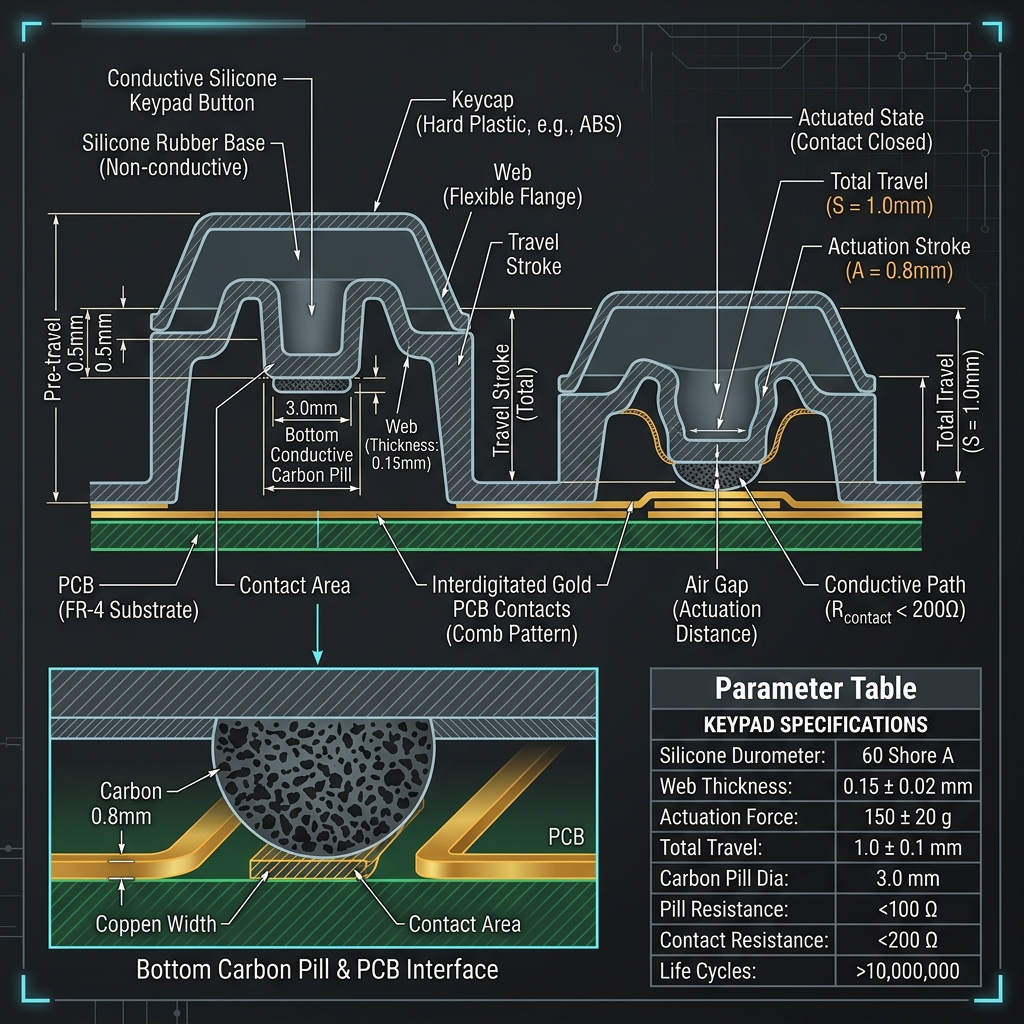
▲ Section diagram showing travel, pre-travel, webbing (web), and bottom contact of a silicone keypad
Jun-Hsiang Enterprise possesses over 30 years of precision mold development capability, offering one-stop tooling services to help you calibrate webbing thickness for the perfect tactile feedback. Our factory is located on Xinshu Road in Xinzhuang, and we welcome you to provide drawings for technical discussion.
Submit 2D/3D CAD Drawings for Quotation
Have a custom silicone or rubber project? Submit your 2D/3D CAD drawings (.STEP, .IGES, .DWG, .PDF) directly via email for evaluation and quotation. We execute mutual Non-Disclosure Agreements (NDA) prior to reviewing any proprietary engineering drawings.